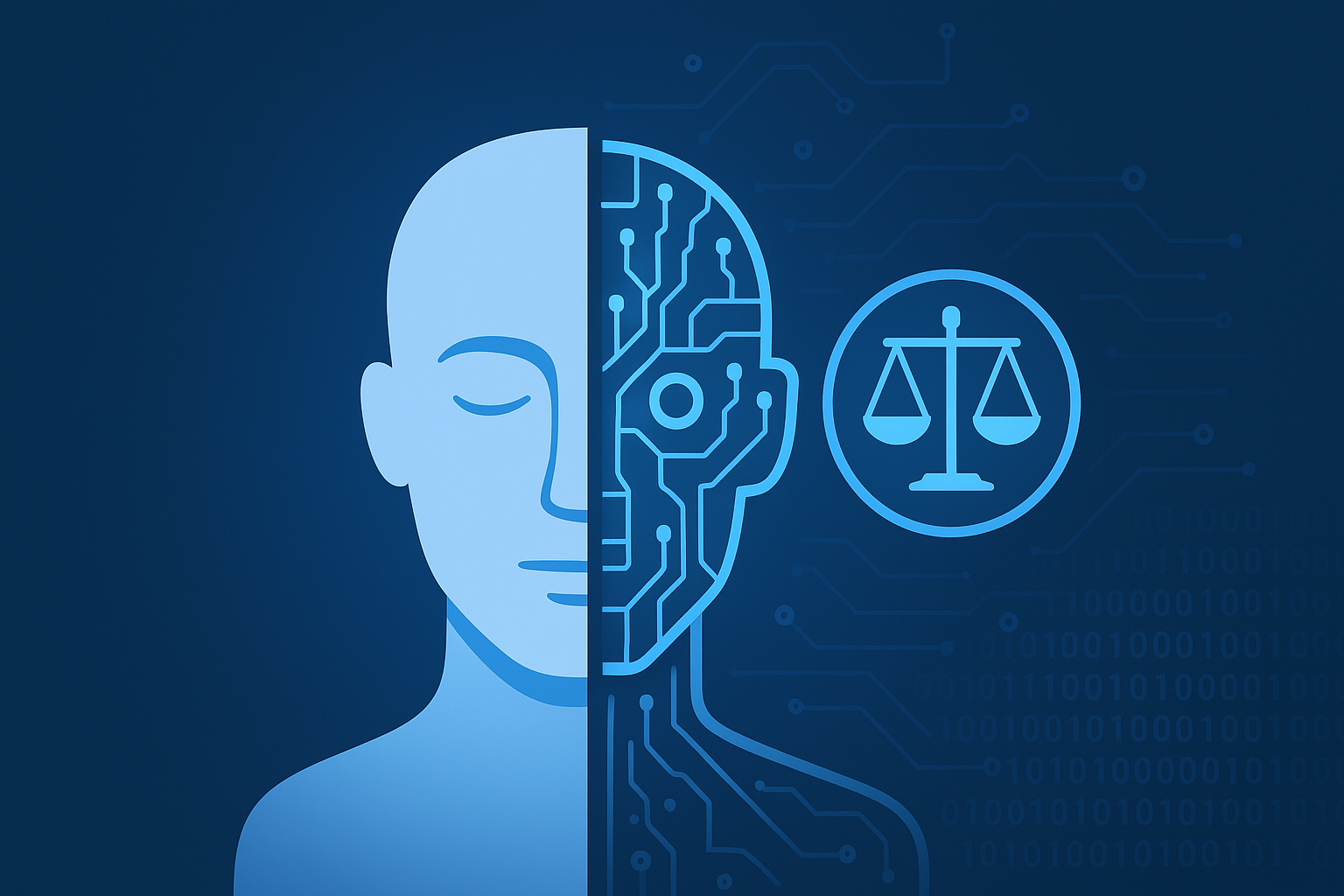
Introduction
Artificial intelligence is transforming industries, shaping decision-making, and influencing everyday life. With great power comes great responsibility. This blog compiles a comprehensive view of ethical AI, drawing on frameworks, governance, real-world issues, and practical steps for organizations, researchers, and practitioners. We’ll cover definitions, key principles, governance structures, common ethical challenges, and actionable guidelines for ethical AI development and deployment.
Table of Contents
What is ethical AI?
- Ethical AI refers to designing, developing, and deploying AI systems in ways that respect human rights, fairness, privacy, transparency, accountability, and societal well-being.
- It encompasses the entire lifecycle: governance, design, data handling, model training, deployment, monitoring, and ongoing evaluation.
54% of teachers express concern about data privacy and algorithmic bias in classroom AI tools.
→ Source: OECD Education & Skills Outlook, 2024
Core principles of ethical AI
- Fairness and non-discrimination: Mitigate biases in data and models to avoid unfair outcomes across groups.
- Accountability and governance: Clear ownership, decision logs, and mechanisms to address harms or failures.
- Transparency and explainability: Provide understandable motivations, limitations, and decision rationales where feasible.
- Privacy and data protection: Safeguard personal data, minimize data collection, and ensure compliant usage.
- Safety and reliability: Build robust systems resistant to manipulation and with fail-safes.
- Human-centered values: Respect autonomy, consent, and the well-being of users and communities.
- Sustainability and social impact: Consider environmental costs and broader societal consequences.
Discover how eco-friendly AI models reduce carbon footprints and power the next generation of ethical technology.
Ethical AI frameworks and guidelines
- International and industry standards: Many organizations reference ISO/IEC guidance, as well as sector-specific norms (e.g., healthcare, education).
- Corporate frameworks: Prominent frameworks include proactive risk assessment, bias auditing, data governance, and incident response plans.
- Global inventory of guidelines: Numerous compilations exist that map ethical AI principles across organizations and jurisdictions, helping teams benchmark practices.
As highlighted in UNESCO’s AI and Education Policy Report, ethical frameworks and digital literacy training are essential to ensure AI tools in education promote equity and human values worldwide.
⚖️ Comparison: Ethical AI vs Traditional AI
| Aspect | Ethical AI (2025 Approach) | Traditional AI (Pre-2025) |
|---|---|---|
| Decision-Making | Guided by fairness, accountability, and human oversight | Driven purely by data and algorithms without ethical checks |
| Data Privacy | Prioritizes user consent, transparency, and GDPR/CCPA compliance | Often collects and uses data without full transparency |
| Bias & Fairness | Regular audits to detect and reduce bias in training data | Bias remains unchecked, leading to unfair or inaccurate outcomes |
| Transparency | Uses explainable AI (XAI) to show how decisions are made | Operates as a “black box” with limited user understanding |
| Governance & Regulation | Aligned with AI Bill of Rights, EU AI Act, and global ethics frameworks | Minimal compliance, few ethical or legal guidelines |
| Public Trust | Builds confidence through openness and responsible innovation | Faces skepticism due to privacy risks and opaque behavior |
| Long-Term Impact | Encourages sustainable, human-centered progress | Prioritizes speed and profit over ethical or social concerns |
Ethical AI in healthcare
- Data privacy and consent: Handling patient data with strict privacy controls and informed consent.
- Clinical safety and accountability: Ensuring AI support tools augment clinicians without undermining accountability.
- Fair access and equity: Preventing disparities in outcomes across populations and ensuring broad benefit.
- Transparency of diagnosis/prognosis tools: Users should understand confidence levels and limitations.
- Governance: Multidisciplinary ethics boards, ongoing monitoring, and clear escalation paths for adverse events.
Discover the latest breakthroughs where AI supports doctors, improves patient outcomes, and safeguards data privacy.
Ethical AI in education and marketing
- Education: Use AI to personalize learning while protecting student data, avoiding biased recommendations, and ensuring transparency about AI involvement.
- Marketing: Avoid manipulative tactics, respect consumer privacy, and disclose AI-generated content where relevant.
According to the World Economic Forum’s insights on Artificial Intelligence, AI is reshaping the global workforce by introducing new digital skills and transforming how students prepare for future jobs.
🎓 AI in Education: Shaping the Classrooms of Tomorrow — Understand how AI enhances personalized learning, assessment, and academic accessibility for all learners.
Ethical AI in art and image generation

- Intellectually fair use: Respect copyright, avoid misrepresentation, and be transparent about AI involvement.
- Content safety: Implement filters to prevent harmful or illegal outputs, and provide user controls for responsible use.
- Artist and creator rights: Acknowledge collaboration dynamics and potential impact on traditional artistic communities.
Ethical AI governance and organizational roles
- AI ethics officer and roles: Designated leadership to oversee ethics, risk management, compliance, and stakeholder engagement.
- Ethics committees and review boards: Cross-disciplinary groups evaluating projects before and during deployment.
- AI governance groups: Coordinate policy, standards, and incident response across the organization.
By 2027, AI-related education roles (data literacy instructors, AI curriculum designers, etc.) are projected to grow by 38%.
→ Source: World Economic Forum, Future of Jobs Report 2024
Ethical AI jobs and salaries
- Roles include AI ethics officer, AI ethics researcher, governance lead, bias auditor, privacy engineer, and responsible AI product manager.
- Salaries vary by region, experience, and the scope of responsibilities. In many markets, senior ethics roles align with senior technical or policy roles, reflecting the interdisciplinary nature of the work.
Finance with AI: Smarter Investments Through Machine Learning — Explore how AI is transforming personal finance, from predictive analytics to fraud detection and portfolio automation.
Ethical AI practices and best practices
- Start with a principled design approach: Integrate ethics from the outset (left-shift ethical considerations into the product development lifecycle).
- Proactive risk assessment: Identify potential harms and biases early (data, model, deployment-phase risks).
- Data governance and provenance: Maintain clear data lineage, consent, and usage policies.
- Bias detection and mitigation: Use diverse datasets, fairness metrics, and regular audits.
- Explainability where feasible: Provide user-friendly explanations for decisions; tailor explanations to the audience (clinician, consumer, student).
- Transparency and disclosure: Inform stakeholders when AI is involved and what limitations apply.
- Continuous monitoring: Post-deployment monitoring for drift, bias, safety, and unintended consequences.
- Incident response and remediation: Clear processes for addressing harmful outcomes and learning from incidents.
- Stakeholder engagement: Involve patients, students, customers, and communities in governance discussions.
- Compliance and certification: Align with legal requirements and pursue relevant ethics or sustainability certifications when available.
Ethical AI challenges and issues
- Bias and discrimination: Even well-intentioned models can reflect or amplify societal biases.
- Privacy concerns: Data collection and usage can infringe on individual rights if not properly protected.
- Transparency vs. performance: Trade-offs between model complexity and explainability.
- Accountability gaps: Determining responsibility for harms or mistakes in AI systems.
- Data quality and representativeness: Training data may not capture diverse realities.
- Security risks: AI systems can be vulnerable to adversarial manipulation or data breaches.
- Misinformation and manipulation: Generative AI can spread falsehoods or be used for manipulation.
- Labor and creativity impact: AI can affect employment and cultural practices in art and media.
Ethical AI guidelines and standards
- Develop a clear code of ethics for AI projects, aligned with organizational values and legal requirements.
- Create pragmatic guidelines for responsible AI use, including risk assessment templates, bias audits, and impact assessments.
- Adopt accountability mechanisms: traceability, documentation, and decision provenance.
- Implement privacy-by-design and data minimization principles.
- Establish governance structures with diverse perspectives, including ethics, legal, clinical, educational, and technical expertise.
What makes ethical AI possible? Common arguments and counterpoints
- Is ethical AI possible? Many experts believe ethical AI is aspirational but achievable through disciplined governance, continuous auditing, and transparent practices. The goal is to minimize harm, maximize beneficial outcomes, and adapt to evolving societal norms.
- Critics argue that fully eliminating bias or unintended consequences is impossible due to data and societal complexity. The pragmatic answer is to design systems that reduce harm, provide redress mechanisms, and maintain human oversight.
🤖 AI in Daily Life: The Invisible Assistant Powering Modern Living — From smart homes to digital assistants, explore how AI simplifies everyday tasks while raising new ethical questions.
How to implement ethical AI in practice
- Start with a formal ethics review: Before building or deploying, assess potential harms, benefits, and the populations affected.
- Build an ethics toolkit: Checklists, risk registers, bias auditing methods, data provenance tracking, and privacy impact assessments.
- Data strategy: Use de-identified or synthetic data where possible; ensure consent and proper use-cases.
- Model governance: Versioning, reproducibility, and regular audits for bias and drift.
- Explainability and user-centric design: Create explanations that are meaningful for the target audience.
- Deployment safeguards: Implement monitoring dashboards, alerting for anomalies, and rapid rollback capabilities.
- External accountability: Engage with regulators, patients, students, or customers, and publish ethics disclosures and impact reports.
- Education and culture: Train teams on ethics, bias, privacy, and responsible AI practices.
- Continuous improvement: Treat ethics as an ongoing program, not a one-off checklist.
Ethical AI education and careers
- Courses and certifications: Look for programs covering AI ethics, governance, and responsible AI design.
- Research and academia: AI ethics researchers explore theoretical and empirical questions about fairness, accountability, and social impact.
- Industry pathways: Many tech companies establish ethics offices, governance councils, and bias auditing teams to steward responsible AI.
AI in Health: Merging Technology with Human Care — Discover the latest breakthroughs where AI supports doctors, improves patient outcomes, and safeguards data privacy.
Ethical AI resources and communities
- Thought leadership and notable authors: Mark Coeckelbergh is a recognized voice in AI ethics, among others.
- Industry groups: AI ethics organizations and governance collectives offer guidelines, case studies, and standards.
- Academic journals and case studies: Explore peer-reviewed research and real-world ethical dilemmas in AI usage.
Ethical AI in policy and governance
- National and international governance: Policymakers are increasingly focusing on AI ethics, safety, and accountability.
- Standards and certification: Certification programs may emerge to validate responsible AI practices.
- Indigenous perspectives and inclusivity: Incorporating diverse cultural viewpoints strengthens ethical governance.

Learn how to boost your legal practice & earnings 10X with FREE AI TOOLS.
This Course of Law & AI is specially designed for:
• Law Students (future-ready career)
• Advocates & Lawyers (grow practice & earnings)
• Corporate Legal Teams (efficiency + compliance)
Practical takeaways for different stakeholders
- For developers and product teams:
- Integrate ethics from the design phase.
- Build in bias detection, privacy protections, and explainability features.
- Establish a clear governance pathway for reviews and approvals.
- For organizations and boards:
- Create an AI ethics officer role and cross-functional governance committee.
- Regularly audit models and data, publish impact reports, and maintain incident response plans.
- For educators and researchers:
- Emphasize critical thinking about AI’s societal impacts.
- Conduct and publish case studies on ethical AI deployment in real-world settings.
- For policymakers and regulators:
- Develop frameworks that balance innovation with protections for rights and safety.
- Encourage transparency, accountability, and independent audits.
Conclusion
Ethical AI is not a single destination but a continuous journey. It requires deliberate governance, ongoing bias mitigation, robust privacy protections, and a culture that prioritizes human-centered outcomes. By embedding ethics into every stage of the AI lifecycle—from conception to deployment and beyond—organizations can build trustworthy systems that maximize benefits while minimizing harms. The evolving landscape includes ongoing debates, new standards, and innovative practices, all aimed at aligning AI with shared human values.
💼 Transform your AI systems with ethics-first innovation — let’s collaborate.
1. What is Ethical AI?
Ethical AI refers to the design and use of artificial intelligence systems that align with human values such as fairness, transparency, accountability, and privacy. Its goal is to ensure AI benefits society without causing harm or bias.
2. Why is Ethical AI important in 2025?
In 2025, AI impacts nearly every sector—from healthcare to finance. As AI becomes more autonomous, ethical guidelines help prevent misuse, protect data privacy, and maintain public trust in technology.
3. How can companies ensure their AI systems are ethical?
Organizations can create internal AI ethics policies, conduct regular bias audits, ensure transparency in data usage, and form multidisciplinary review teams to oversee AI deployment and compliance.
4. What role does transparency play in Ethical AI?
Transparency allows users to understand how AI decisions are made. In 2025, transparent algorithms and explainable AI (XAI) models are key to building trust, enabling accountability, and meeting regulatory standards.
5. What are the key principles of building responsible AI?
The main principles include fairness, privacy, accountability, human oversight, and inclusivity. Following these ensures AI systems remain beneficial, secure, and free from harmful bias.
6. How do AI regulations and governance affect Ethical AI development in the U.S.?
New U.S. and global AI policies (such as the AI Bill of Rights and EU AI Act) require companies to prove their systems are transparent, safe, and non-discriminatory. These frameworks are reshaping corporate AI governance in 2025.
7. Can AI systems self-regulate or enforce ethical behavior autonomously?
While research is advancing toward self-regulating AI models, current technology still requires human oversight. Ethical parameters can be embedded, but full autonomy raises complex moral and legal challenges yet to be solved.
